Course Response Rate
| Raters | Students |
|---|---|
| Responded | 6 |
| Invited | 9 |
| Response Ratio | 67% |

Course General Questions
| Count | Excellent | Very Good | Good | Fair | Unsatisfactory | Course Mean | FAS Mean | |
|---|---|---|---|---|---|---|---|---|
| Evaluate the course overall. | 6 | 83% | 0% | 17% | 0% | 0% | 4.67 | 4.26 |
| Course materials (readings, audio-visual materials, textbooks, lab manuals, website, etc.) | 6 | 83% | 0% | 17% | 0% | 0% | 4.67 | 4.24 |
| Assignments (exams, essays, problem sets, language homework, etc.) | 6 | 50% | 33% | 17% | 0% | 0% | 4.33 | 4.14 |
| Feedback you received on work you produced in this course | 6 | 50% | 50% | 0% | 0% | 0% | 4.50 | 4.14 |
| Section component of the course | 1 | 100% | 0% | 0% | 0% | 0% | 5.00 | 4.29 |

General Instructor Questions
| Count | Excellent | Very Good | Good | Fair | Unsatisfactory | Instructor Mean | FAS Mean | |
|---|---|---|---|---|---|---|---|---|
| Evaluate your Instructor overall. | 6 | 67% | 33% | 0% | 0% | 0% | 4.67 | 4.54 |
| Gives effective lectures or presentations, if applicable | 6 | 83% | 17% | 0% | 0% | 0% | 4.83 | 4.46 |
| Is accessible outside of class (including after class, office hours, e-mail, etc.) | 6 | 50% | 33% | 17% | 0% | 0% | 4.33 | 4.52 |
| Generates enthusiasm for the subject matter | 6 | 83% | 17% | 0% | 0% | 0% | 4.83 | 4.61 |
| Facilitates discussion and encourages participation | 6 | 83% | 17% | 0% | 0% | 0% | 4.83 | 4.59 |
| Gives useful feedback on assignments | 6 | 100% | 0% | 0% | 0% | 0% | 5.00 | 4.52 |
| Returns assignments in a timely fashion | 6 | 100% | 0% | 0% | 0% | 0% | 5.00 | 4.49 |
On average, how many hours per week did you spend on coursework outside of class? Enter a whole number between 0 and 168.
Frequency chart and mean excludes students who answered 31 or more hours.
On average, how many hours per week did you spend on coursework outside of class? Enter a whole number between 0 and 168.
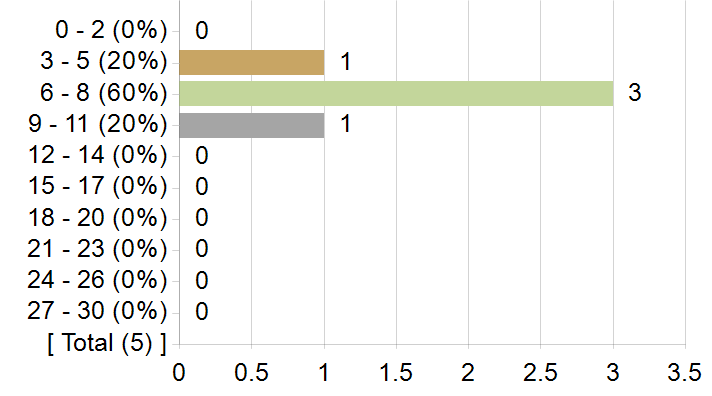
| Statistics | Value |
|---|---|
| Response Count | 5 |
| Response Ratio | 56% |
| Mean | 7.40 |
| Median | 8.00 |
| Mode | 8 |
| Standard Deviation | 1.95 |
How strongly would you recommend this course to your peers?
How strongly would you recommend this course to your peers?

| Options | Score | Count | Percentage |
|---|---|---|---|
| Recommend with Enthusiasm | 5 | 4 | 67% |
| Likely to Recommend | 4 | 1 | 17% |
| Recommend with Reservations | 3 | 0 | 0% |
| Unlikely to Recommend | 2 | 1 | 17% |
| Definitely not Recommend | 1 | 0 | 0% |
| Statistics | Value |
|---|---|
| Response Ratio | 67% |
| Mean | 4.33 |
| Median | 5.00 |
| Standard Deviation | 1.21 |
What was/were your reason(s) for enrolling in this course? (Please check all that apply)
| Options | Count |
|---|---|
| Elective | 3 |
| Concentration or Department Requirement | 3 |
| Secondary Field or Language Citation Requirement | 0 |
| Undergraduate General Education Requirement | 0 |
| Expository Writing Requirement | 0 |
| Foreign Language Requirement | 0 |
| Pre-Med Requirement | 0 |
| Divisional Distribution Requirement | 0 |
| Quantitative Reasoning with Data Requirement | 0 |
In this course, most students listen attentively with an open mind and a willingness to change their point of view as they learn more about the topic.
In this course, most students listen attentively with an open mind and a willingness to change their point of view as they learn more about the topic.

| Options | Score | Count | Percentage |
|---|---|---|---|
| Strongly Agree | 5 | 3 | 50% |
| Agree | 4 | 2 | 33% |
| Neither Agree nor Disagree | 3 | 1 | 17% |
| Disagree | 2 | 0 | 0% |
| Strongly Disagree | 1 | 0 | 0% |
| Statistics | Value |
|---|---|
| Response Ratio | 67% |
| Mean | 4.33 |
| Median | 4.50 |
| Standard Deviation | 0.82 |
In this course (including sections), I feel comfortable expressing my views on controversial topics.
In this course (including sections), I feel comfortable expressing my views on controversial topics.

| Options | Score | Count | Percentage |
|---|---|---|---|
| Strongly Agree | 5 | 4 | 67% |
| Agree | 4 | 2 | 33% |
| Neither Agree nor Disagree | 3 | 0 | 0% |
| Disagree | 2 | 0 | 0% |
| Strongly Disagree | 1 | 0 | 0% |
| Statistics | Value |
|---|---|
| Response Ratio | 67% |
| Mean | 4.67 |
| Median | 5.00 |
| Standard Deviation | 0.52 |
Comments from students
What would you like to tell future students about this class? (Your response to this question may be published anonymously.)
| Comments |
|---|
| This course is a heavy workload, but in a way that ultimately serves a thorough, thoughtful process in understanding the complexities of the social welfare system, and the history of its development in the United States. The discussions each week were my favorite part of my classes, and I am a better scholar for having gone through this course. |
| Hands down, this was one of the best courses I have taken at Harvard. Dr. Aumoithe is an incredible instructor, highly knowledgeable about the field, and with an incredible capacity to integrate history, economics, politics, and social theory. I knew a lot about the American healthcare system prior to taking this course, but it fundamentally changed the way I thought about the system and its issues by contextualizing it within the broader American welfare state. Now, I feel that I have a much better appreciation for the development of the American healthcare system, as well as how it reflects certain particular aspects of the American state and national identity. There is a fair amount of reading in this course (~150 pages per week), and Dr. Aumoithe has high expectations for assignment quality. However, if you are willing to put in the time and effort that this course requires, you will get so much out of it! |
| Definitely take it but be prepared to do the readings and come to class prepared! |
| This is a fantastic primer on the history of the U.S. health care system. You'll learn about a variety of topics, mostly in chronological order: the early roots of the health and welfare system in widows' benefits and veterans pensions, the development of Social Security, the birth of Medicare and Medicaid, and the unfolding of the delegated/privatized state in the post–1960s era. George is a fantastic guide: he is unique in his attention to detail, and truly wants each student to leave the course a better writer and historical thinker than they entered it. He is also passionate and not afraid to offer his opinion on historical change in the health care system –– which I found refreshing. This class never bores. Take it! |
| This is a hard course with a good amount of reading. Prof knows his stuff but has very high expectations. |